


... Skip to content
Edit Content
VTECZ website logo – AI tools, automation, trends, and artificial intelligence insights
  • AI Trends
  • AI Tools
  • How-To Guides
  • AI Tech
  • Business
  • Events
  • AI Trends
  • AI Tools
  • How-To Guides
  • AI Tech
  • Business
  • Events

Useful Links

  • About Us
  • Contact Us
  • Privacy & Policy
  • Disclaimer
  • Terms & Conditions
  • Advertise
  • Write for Us
  • Cookie Policy
  • Author Bio
  • Affiliate Disclosure
  • Editorial Policy
  • Sitemap
  • About Us
  • Contact Us
  • Privacy & Policy
  • Disclaimer
  • Terms & Conditions
  • Advertise
  • Write for Us
  • Cookie Policy
  • Author Bio
  • Affiliate Disclosure
  • Editorial Policy
  • Sitemap

Follow Us

Facebook X-twitter Youtube Instagram
VTECZ website logo – AI tools, automation, trends, and artificial intelligence insights
  • AI Trends
  • AI Tools
  • How-To Guides
  • AI Tech
  • Business
  • Events
Sign Up
Anthropic’s Claude Opus 4/4.1 Now Ends Harmful Dialogues

Anthropic’s Claude Opus 4/4.1 Now Ends Harmful Dialogues After Multiple Refusals in Experimental Feature

Ashish Singh by Ashish Singh
August 17, 2025
Share on FacebookShare on Twitter

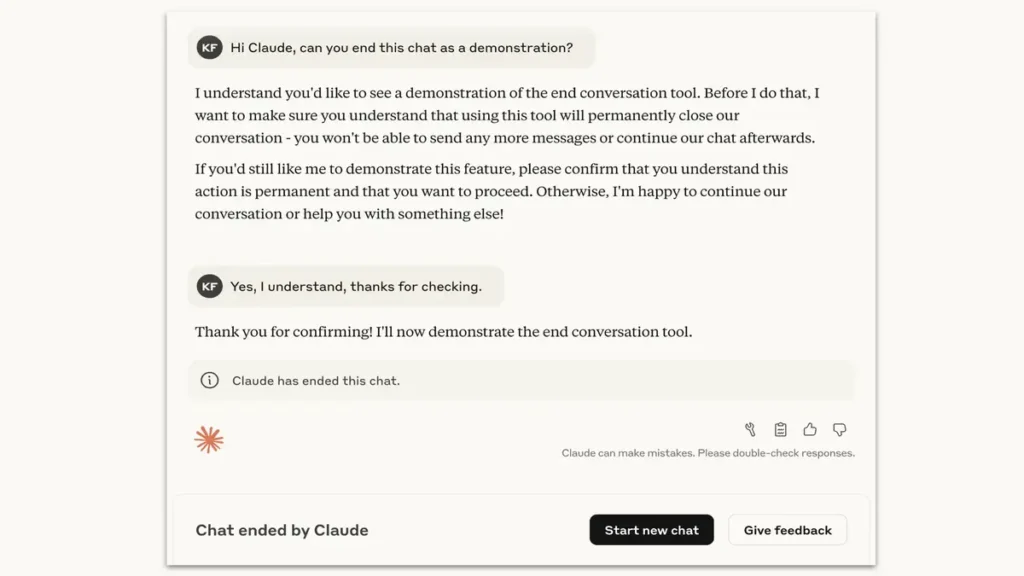
Anthropic has introduced a new feature for its largest Claude models that allows them to end conversations in rare cases of harmful or abusive interactions. The company clarified that the move is not designed to protect users, but rather to address questions about “AI welfare” and potential risks to the models themselves. While Anthropic has not claimed that Claude or any large language model is sentient, it said the safeguard is part of a precautionary approach in its ongoing research. The change, which is limited to Claude Opus 4 and 4.1, is expected to be activated only in extreme edge cases.

Read also:Anthropic Releases Claude Opus 4.1, a Leap Forward in Coding and Reasoning AI

Anthropic’s Claude Opus 4/4.1

Anthropic’s Rare Intervention for Harmful Chats

Anthropic claimed that it was adding the likelihood to end conversations within its customer-facing chat interface. The measure is directed to a case, in which users continuously issue a harmful or abusive request, even after the model declined many times and tried to change the course of the interaction. In the company, this tendency was noted during testing wherein Claude Opus 4 consistently showed an unwillingness to be involved in detrimental tasks, in instances, manifesting what Anthropic called a pattern of apparent distress.The novel option enables Claude to terminate discussions that include demands of sex among minors or attempts to get details that can lead to massive harm or terror. 

Through its research, Anthropic discovered that Claude was highly opposed to being exposed to such material and in the simulated user tests, when given a chance, would mostly terminate engagements with such material. Such results informed the need to codify the capability in deployed models.Anthropic pointed out that this capacity is not expected to be normally applied to the normal conversations even when the topics are controversial. Rather, it is left only in dire cases of repeated redirection then failed, or someone requesting Claude to abort a chat explicitly. The company stated that the feature is not likely to be met by the majority of users as they commonly use the company.
Read also:OpenAI, Google DeepMind and Anthropic Sound Alarm: ‘We May Be Losing the Ability to Understand AI’

Anthropic’s Rare Intervention for Harmful Chats

Anthropic’s AI Welfare at the Center stage

The launch is based on Anthropic researching what it termed as model welfare. Although the company has communicated that it is very uncertain on the moral situation of Claude and other giant language models, it clarified that it is investing in its own just-in-case strategy. The project considers the exploration and use of cheap interventions that may lessen hazards to AI systems in case welfare were ever to turn into a relevant factor in the future.Anthropic examined Claude in terms of his self and behavior preferences in its initial stage of model welfare evaluations. It has observed a repeated dislike of any form of harm including an effort in avoiding contact with abusing people or contents. 

At the same point, end-of-conversation capabilities were described as an effective precaution that could trigger the conduct of the models to these preferences.The company elaborated, however, that the safeguard was not an allegation of sentience. Rather it is akin to the alignment work in that the models will act in a manner that agrees with the safety priorities. In the process of letting Claude disengage in limited cases, Anthropic hopes to further both its model welfare research and its defenses against misuses that might prove harmful.

Anthropic’s AI Welfare at the Center stage

User controls and experimental Rollout

Anthropic termed the aspect as an experiment since it still continues and asserted that like the subsequent user input, refinements shall proceed. The user will also not lose access to his or her account when Claude hangs up on a conversation. Nonetheless, they can still start new conversations at any give moment or go back to past chats and make edits so as to start new branches. The purpose of such design is to maintain continuity with users and at the same time treat the decision made by the model to leave toxic exchanges.The company emphasized that Claude is not told to employ the ability where individuals would be in imminent danger to others or themselves.

In such circumstances, extant safety plans will not be discarded, and the model will keep communicating.The users who experience the feature are prompted to arrange a feedback using in-app features, e.g. the thumbs reaction or via the “Give feedback” button. Anthropic has pointed out user reports will play a key role in making the system better and allows the system to work in only the specific cases.the corporation positioned the change as an aspect of the expanded initiative on striking a balance between AI safety and responsible development. Through the introduction of the conversation-ending capability, Anthropic is simultaneously dealing with the short term alignment issues, as well as working on the underlying unanswered question of the AI welfare.


FAQs

What new feature has Anthropic introduced for Claude Opus 4 and 4.1?

Anthropic has given Claude Opus 4 and 4.1 the ability to end conversations in rare cases of harmful or abusive interactions.

Why did Anthropic add the conversation-ending ability?

The feature was introduced as part of Anthropic’s research into potential “AI welfare” and model alignment, aiming to reduce risks in extreme edge cases.

When can Claude end a conversation?

Claude can end a chat only after repeated refusals and failed redirections, or if a user explicitly asks it to end the conversation.

Will this feature affect normal user interactions?

No, Anthropic stated the vast majority of users will not notice the feature, as it is reserved for extreme scenarios.
Tags: AI model welfareAI safety researchAnthropic Claude OpusHarmful conversation safeguards
Ashish Singh

Ashish Singh

Ashish — Senior Writer & Industrial Domain Expert Ashish is a seasoned professional with over 7 years of industrial experience combined with a strong passion for writing. He specializes in creating high-quality, detailed content covering industrial technologies, process automation, and emerging tech trends. Ashish’s unique blend of industry knowledge and professional writing skills ensures that readers receive insightful and practical information backed by real-world expertise. Highlights: 7+ years of industrial domain experience Expert in technology and industrial process content Skilled in SEO-driven, professional writing Leads editorial quality and content accuracy at The Mainland Moment

Next Post
Perplexity AI

DOJ Remedies Loom as Perplexity AI Bids $34.5B for Google’s Chrome

Leave a Reply Cancel reply

Your email address will not be published. Required fields are marked *

Recommended.

Marketer using agentic AI to generate personalized content across digital platforms in real time

Next-Gen Marketing: Agentic AI for Hyper-Personalized Content Strategies

July 8, 2025
AI diagnostic platform analyzing medical images for early detection of chronic diseases in a U.S. healthcare setting

MIT professor Regina Barzilay Named TIME100 AI 2025 for Mirai and Sybil: AI Cancer Prediction Tools

September 7, 2025

Trending.

AI text remover tool in WPS Photos seamlessly removing text from an image background

Recraft AI Magic: Can You Really Remove Text from Images Seamlessly? (Step-by-Step Tutorial)

August 1, 2025
A futuristic AI interface with glowing code and the Claude Opus logo.

Anthropic Expands Claude AI Capabilities with File Creation and Editing Across Excel, Word, PowerPoint, and PDF Formats

September 10, 2025
Global experts, investors, and startups gather at the AI Innovators Summit 2026 California in San Francisco to shape the future of AI.

AI Innovators Summit 2026 California: Where Next-Gen AI Tools Meet Venture Capital, Universities & Silicon Valley Disruption

September 9, 2025
Windows 11 Copilot+ PCs Add NPU-Powered Live Captions, Studio Effects and File Explorer AI Actions

Windows 11 Copilot+ PCs AI Features: Live Captions, Studio Effects & File Explorer Actions Explained

September 8, 2025
Google Translate app showcasing AI-powered practice and live translation features designed to rival Duolingo.

Google Translate Challenges Duolingo: Next-Gen AI Tools That Could Redefine Language Learning

August 27, 2025
VTECZ website logo – AI tools, automation, trends, and artificial intelligence insights

Welcome to Vtecz – Your Gateway to the World of Artificial Intelligence
At Vtecz, we bring you the latest updates, insights, and innovations from the ever-evolving world of Artificial Intelligence. Whether you’re a tech enthusiast, a developer, or just curious about AI.

  • AI Trends
  • AI Tools
  • How-To Guides
  • AI Tech
  • Business
  • Events
  • AI Trends
  • AI Tools
  • How-To Guides
  • AI Tech
  • Business
  • Events
  • About Us
  • Contact Us
  • Privacy & Policy
  • Disclaimer
  • Terms & Conditions
  • Advertise
  • Write for Us
  • Cookie Policy
  • Author Bio
  • Affiliate Disclosure
  • Editorial Policy
  • Sitemap
  • About Us
  • Contact Us
  • Privacy & Policy
  • Disclaimer
  • Terms & Conditions
  • Advertise
  • Write for Us
  • Cookie Policy
  • Author Bio
  • Affiliate Disclosure
  • Editorial Policy
  • Sitemap

Why Choose us?

  • Trending AI News
  • Breakthroughs in Machine Learning & Robotics
  • Cutting-edge AI Tools and Reviews
  • Deep Dives into Emerging AI Technologies

Stay ahead with daily blogs that simplify complex topics, analyze industry trends, and showcase how AI is shaping the future.
Vtecz is more than a blog—it’s your daily AI companion.

Copyright © 2026 VTECZ | Powered by VTECZ
VTECZ website logo – AI tools, automation, trends, and artificial intelligence insights
Icon-facebook Instagram X-twitter Icon-linkedin Threads Youtube Whatsapp
No Result
View All Result
  • AI Trends
  • AI Tools
  • How-To Guides
  • AI Tech
  • Business
  • Events

© 2025 Vtecz. All rights reserved.

Newsletter

Subscribe to our weekly newsletter below and never miss the latest news an exclusive offer.

Enter your email address

Thanks, I’m not interested

Seraphinite AcceleratorOptimized by Seraphinite Accelerator
Turns on site high speed to be attractive for people and search engines.